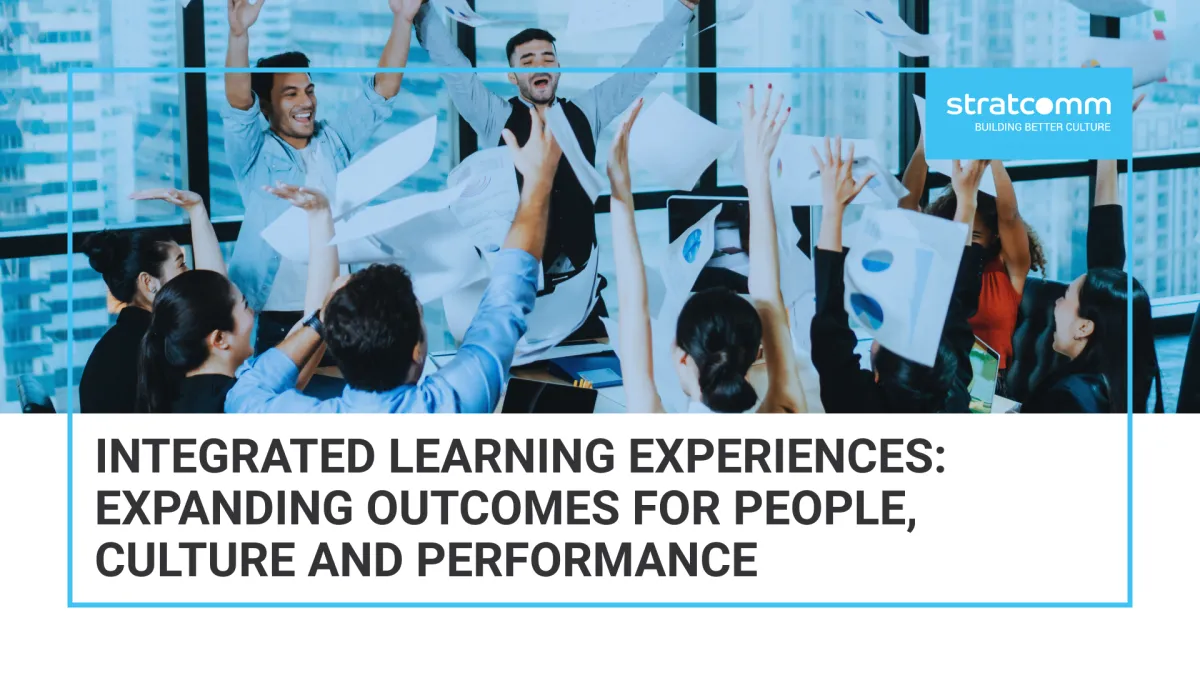
Integrated Learning Experiences: Expanding Outcomes for People, Culture and Performance
Offsite learning has long been valued by individuals. Time away from the normal work environment can create space to think differently, connect more openly and step out of the patterns that often shape everyday workplace behaviour. For organisations, however, the value of offsite learning can be harder to measure.
The return is not always immediate or easily captured in a single metric. The most important outcomes may show up in the quality of conversations, the strength of peer relationships, the willingness to contribute, the confidence to apply new skills and the way people return to work with a broader view of their role in the organisation.
This is why the conversation needs to move beyond offsite learning as a training event. In 2026, the real opportunity is to design integrated learning experiences that connect individual insight with organisational outcomes.
An integrated learning experience is not simply a workshop held away from the office. It is a deliberate learning environment that gives people space to reflect, practise, collaborate and apply new thinking to real organisational challenges. It brings people out of the usual setting so they can interrupt familiar patterns, explore different perspectives and reconnect with shared purpose.
The value of this kind of learning is not found only in the content delivered. It is found in the experience created around that content.
When people learn together away from the immediate demands of their roles, they often relate to each other differently. A manager becomes a person with pressures, hopes and blind spots. A colleague from another team becomes a source of insight rather than a name on an email trail. A senior leader becomes more accessible. A long-standing issue can be explored with a little more distance and a little less defensiveness.
That shift matters.
Relationships have a direct impact on organisational performance. Stronger peer relationships can support more open communication, earlier conflict resolution, clearer expectations and greater trust. When people know each other beyond functional roles, they are often more willing to ask questions, challenge assumptions and work through issues directly rather than relying on policy, hierarchy or avoidance to manage tension.
This is not an argument against structure. Policies, procedures and systems all matter. However, organisations function best when those structures are supported by strong human relationships. People are more likely to apply judgement, show initiative and communicate effectively when trust already exists.
Integrated learning experiences can help build that trust.
They create opportunities for people to work through real scenarios, test ideas, explore consequences and practise new behaviours in a lower-risk environment. Scenario-based learning can be particularly useful because it allows participants to examine workplace situations without the immediate pressure of operational consequences. People can see how different decisions land, how communication changes outcomes and how assumptions influence the way problems are understood.
This is where learning becomes more than knowledge acquisition.
The strongest learning experiences help people make sense of themselves, their colleagues and the organisation they are part of. They create space for individual insight, but they also connect that insight to action. Without this connection, learning can remain personally meaningful yet organisationally underutilised.
At Stratcomm, we believe employees are one of an organisation’s greatest assets because they understand what works, where the gaps are and what gets in the way of better outcomes. Learning experiences should not treat employees as passive recipients of information. They should invite employees to contribute insight, explore possibilities and understand how their role connects to broader organisational performance.
This is the foundation of Inspired Engagement.
Inspired Engagement recognises that individuals need opportunities to develop insight, take action and expand outcomes. Organisations must reflect, respond and integrate feedback if they want learning to become sustainable change. A learning experience is most powerful when it creates a pathway from personal awareness to shared organisational action.
That pathway is often missing.
Many organisations invest in training without creating the conditions for people to apply what they have learned. Employees return to the same workloads, the same systems, the same communication patterns and the same cultural barriers that limited performance in the first place. If nothing in the environment supports application, learning quickly fades into memory rather than becoming practice.
This is why learning transfer must be designed before the program begins.
Organisations need to ask what performance gap the learning is intended to address, what behaviours need to shift, what support participants will need when they return and how leaders will reinforce the application of new skills. Learning design cannot sit separately from organisational development. It needs to connect with strategy, culture, leadership, team dynamics and operational realities.
The learning environment itself also matters.
A change in setting can create a change in thinking. Away from the usual meeting rooms, interruptions and role-based routines, people often have more space to reflect and engage. The shift in environment can support creativity, psychological safety and deeper participation when the experience is well facilitated. It can also signal that the organisation sees learning as valuable, not simply as another task squeezed into an already crowded day.
However, offsite learning should not be treated as a reward without purpose. Nor should it be designed as an isolated experience that feels inspiring in the moment but disconnected from the workplace people return to. The true value lies in integration.
Before the learning experience, organisations need clarity about purpose. Why are people coming together? What organisational outcomes are being supported? What cultural patterns need attention? What capability needs to be strengthened? What conversations have not yet happened?
During the experience, participants need more than content. They need meaningful facilitation, relevant scenarios, reflection, peer collaboration and a safe structure for honest discussion. They need to be able to connect the learning to their own roles, relationships and decisions.
After the experience, organisations need follow-through. What insights were generated? What themes emerged? What needs to be acted on? How will managers support application? How will teams continue the conversation? How will the organisation know whether the learning has translated into better outcomes?
This is the difference between learning as an event and learning as an organisational pathway.
Integrated learning experiences can also make an important contribution to culture. Traditional measures of culture often focus on visible outcomes such as retention, absenteeism, turnover, complaints, safety incidents, workers compensation claims or documented processes. These measures matter, but they may not reveal the deeper shifts that influence employee experience.
Trust is harder to measure. Feeling valued is harder to measure. Willingness to contribute is harder to measure. The quality of informal communication is harder to measure. Yet these are often the areas where culture is most clearly felt.
When learning experiences are designed well, they can bring these less visible elements into the open. They can help people name what is working, identify what is getting in the way and explore how their own behaviour contributes to the culture they experience. They can also help organisations understand the link between individual insight and broader outcomes.
This is especially important in workplaces that are hybrid, dispersed, operationally complex or undergoing change. People may be working across locations, time zones, functions or rosters. They may not have regular opportunities to build rapport or understand each other’s context. In these environments, structured learning experiences can create connections that do not happen naturally in the flow of work.
Connection supports capability.
When people understand each other better, collaboration becomes easier. When teams have shared language, they can address issues earlier. When employees can practise new approaches together, they are more likely to use them back in the workplace. When leaders listen to what emerges from the learning experience, they gain insight that can strengthen culture and performance.
For organisations, this creates a broader view of return on investment.
The value of learning is not only whether participants enjoyed the program or remembered the content. It is whether the experience helped people apply skills, improve relationships, solve problems, communicate more effectively and contribute to the organisation’s goals. It is whether insight became action.
In the current environment, this matters more than ever. Organisations are asking people to adapt to new technologies, changing expectations, increasing regulatory complexity and shifting models of work. The ability to learn, reflect and apply new thinking is now central to resilience and performance.
Integrated learning experiences offer a practical way to develop that capability.
They bring people together with intention. They create space for reflection and connection. They support the transfer of learning into real work. They help organisations align people, culture and performance around shared outcomes.
For organisations that genuinely want to develop employees as individuals while strengthening capability and culture, offsite and integrated learning experiences remain a valuable strategy. Their greatest impact comes when they are not treated as isolated events, but as part of a broader approach to organisational development.
The real upside is not simply that people learn something new.
It is that they return with stronger relationships, clearer insight and a more practical pathway for turning learning into action.


